

Two young men discovered a gap in the market in Scotland in the 19th century: the trade in fresh corpses. At that time, dead bodies from executions were mainly used for medical studies - which got many professors at medical universities into trouble.
It was cold on this Wednesday in January 1829, but 25,000 people did not want to miss this spectacle. They stared spellbound at the platform where the noose had just been placed around 37-year-old William Burke's neck. When the rope was tightened to the booing of the spectators, it marked the end of a terrible series of murders.
William Burke just wanted a better life. There was no work in Ireland, no prospects. When workers were needed for the construction of the ScottishUnion Canal, Burke decided to turn his back on his homeland. He was pleasantly surprised to find another Irishman on the construction site: William Hare. The two had a lot in common and quickly became friends. When Hare suggested that his colleague move into his wife's rented house, Burke didn't think twice. If you work hard, you can party, they say. Burke and Hare took this saying seriously. They really let it rip and quickly gained a certain reputation.
How it all began.
The tenement at the top end of Grassmarket provided a home for people from all walks of life. It was no great surprise when one of the tenants in the house died on November 29, 1827: Donald had been struggling with alcoholism for a long time. Due to his passion for hard liquor, he had not been very careful with his rent payments. When the body was placed in the coffin, Hare remembered a statement made by his friend. The medical student mentioned that there was a shortage of corpses at the university. It was a catastrophe, he said, because how can you practise medicine if you don't know exactly where the liver is? It was so bad that Professor Knox would even pay money for a fresh corpse.
Hare suddenly realized how he was going to get the missing rental income from Donald. He and Burke broke open the coffin in the evening, removed the body and filled it with waste from a local tanner. The coffin, thus prepared and nailed up again, went on its final journey the next day.
They took Donald's body, which they had hidden under the bed at night, to the University of Edinburgh the next day and collected seven pounds for the dead body. This allowed her to pay some long overdue bills.

Then they got greedy ...
After the deal for Donald's body had gone so easily, Burke and Hare became greedy. Impatient, they didn't want to wait for someone to die. They took matters into their own hands. This was the beginning of a series of murders that claimed a total of 16 victims.
The procedure was always the same: the victims were filled with whiskey while celebrating together. Hare then held their mouths and noses shut with his hands while Burke lay on his chest with his full body weight. Due to their previous excessive alcohol consumption, the victims put up little resistance. This method had several advantages: For one, it required little force to execute. If, for any reason, the victim did manage to catch his breath, Burke's weight would quickly force it out of his lungs. Secondly, this method was virtually impossible for forensic experts of the time to prove as a murder.
In the months that followed, many of Burke and Hare's party guests died. Dr. Knox paid between seven and ten pounds per corpse and asked no questions.
The end began with the search for a pair of socks.
But then the tide turned. One of their victims, Margeret Dochety, was found by another tenant before Burke and Hare could take her to Dr. Knox. Ann and James Grey just wanted to get their socks, which they had taken off at the party that evening. They had left the private party a little earlier, while the two men and the Irishwoman Dochety were still having fun. But instead of the socks they were looking for, they found their drinking friend. She was lying dead at the end of the bed with her face covered in blood and saliva. She had obviously fought for her life. Unsuccessfully.
Shocked by the sight, the Greys immediately rushed to the police and reported the murder. Meanwhile, Burke and Hares quickly took the body to the university. After receiving ten pounds for the body, the two made their way home. They told the police, who were already waiting at their house, that Dochety had already left.
Traces of blood on the bed and mutual, inconsistent statements from the two murderers meant that they ended up in court after all. Dochety's body was eventually found in the University of Edinburgh's forensic department thanks to tips from the public.
The process
Burke and Hare were brought to trial. Burke's friend and partner in the murders, William Hare, testified against him before the judge and jury. He stated that Burke was the mastermind and string-puller behind the crimes. As a result, he got off scot-free.
Dr. Robert Knox, who had bought the bodies from the murderers, was not charged because of a letter of exoneration. "Doctor Knox never encouraged or taught me to commit murder," Burke wrote at the time. (Statement from January 1829)
After Burke's lawyer gave a two-hour closing argument, the jury retired. After fifty minutes, the jury had reached its decision: death by hanging.
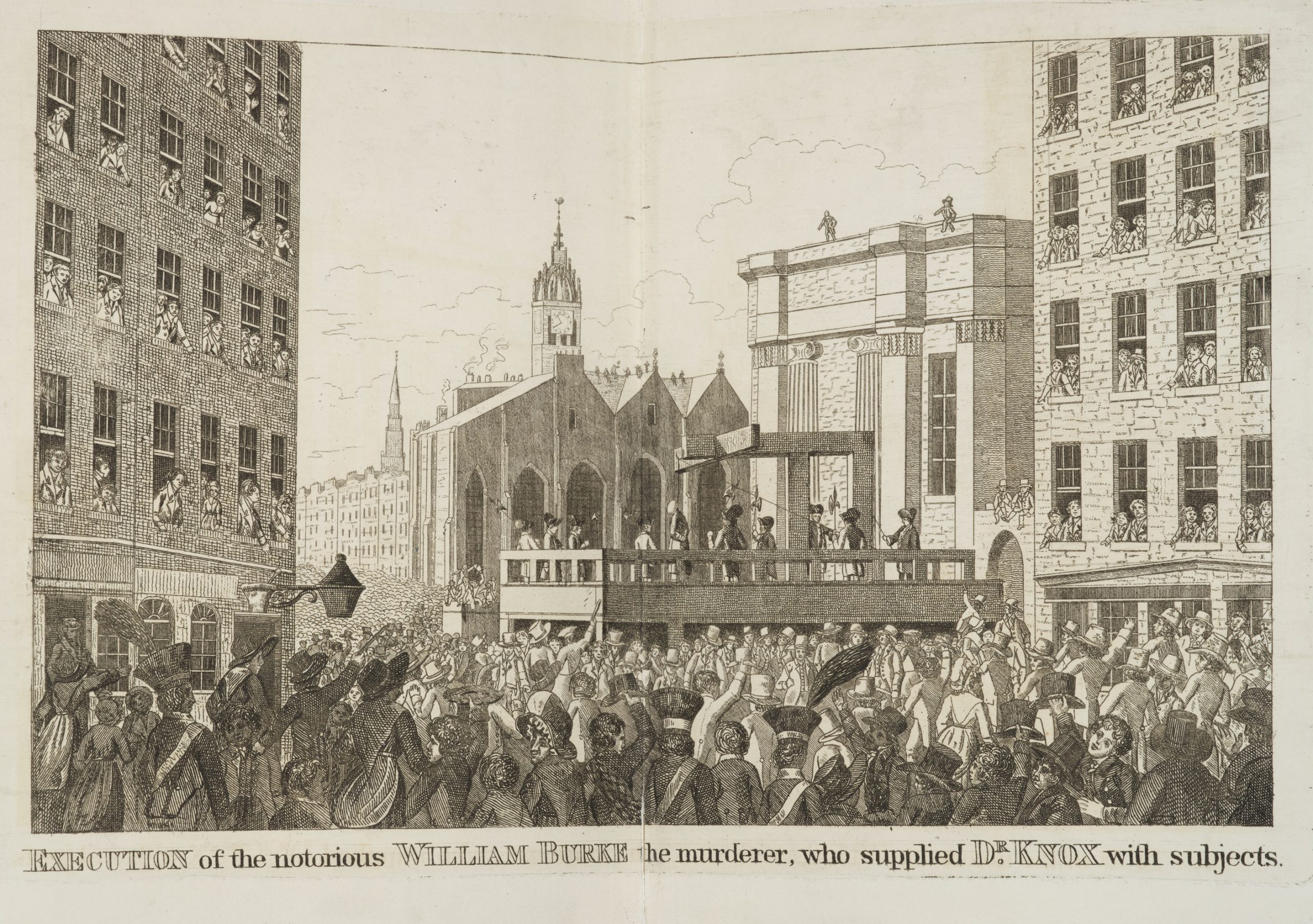
Burke was publicly executed on January 28, 1829 in front of more than twenty thousand spectators. Three days later, his body was dissected in public by Professor Monro. The interest in this procedure was so great that there were even fights among the spectators for the best seats.
After the two-hour procedure, the professor dipped his pen in the dead man's blood. He wrote on a sheet "This is written with Burke's blood taken from his skull".
That's what you call irony
Burke's skeleton was given to the Anatomy Museum of the Medical Faculty of Edinburgh. It is still available to medical students there to this day. His death mask and a book with a cover made of Burke's skin are on display in the Surgeons Hall Museum. Other parts of his skin were also turned into souvenirs because of his fame. For example, a business card case made from the skin of his left hand was auctioned off by the British auction house Phillips in 1988 for GBP 1,050 (approx. EUR 1,250)*.
Burke's accomplice Hare was released from prison on February 5, 1829. His whereabouts are unknown.

Addendum:
Shortly after the end of Burke, the Anatomy Act of 1832 was signed. It stated that doctors and medical students were allowed to dissect donated corpses. This meant that they no longer had to wait for a body from an execution. A major step forward for medicine.
Are you also tired of the constant pop-up windows and advertisements? To avoid this, please support independent journalism. Thank you.
Sources:
Source: Scottish National Museum
University of Edinburgh
Britannica(https://www.britannica.com/biography/William-Burke-and-William-Hare)
Photocredit:
National Scottish Museum
and picture (1) Ingrid Müller
*Value of the British pound as at September 21, 2024

Add a Comment