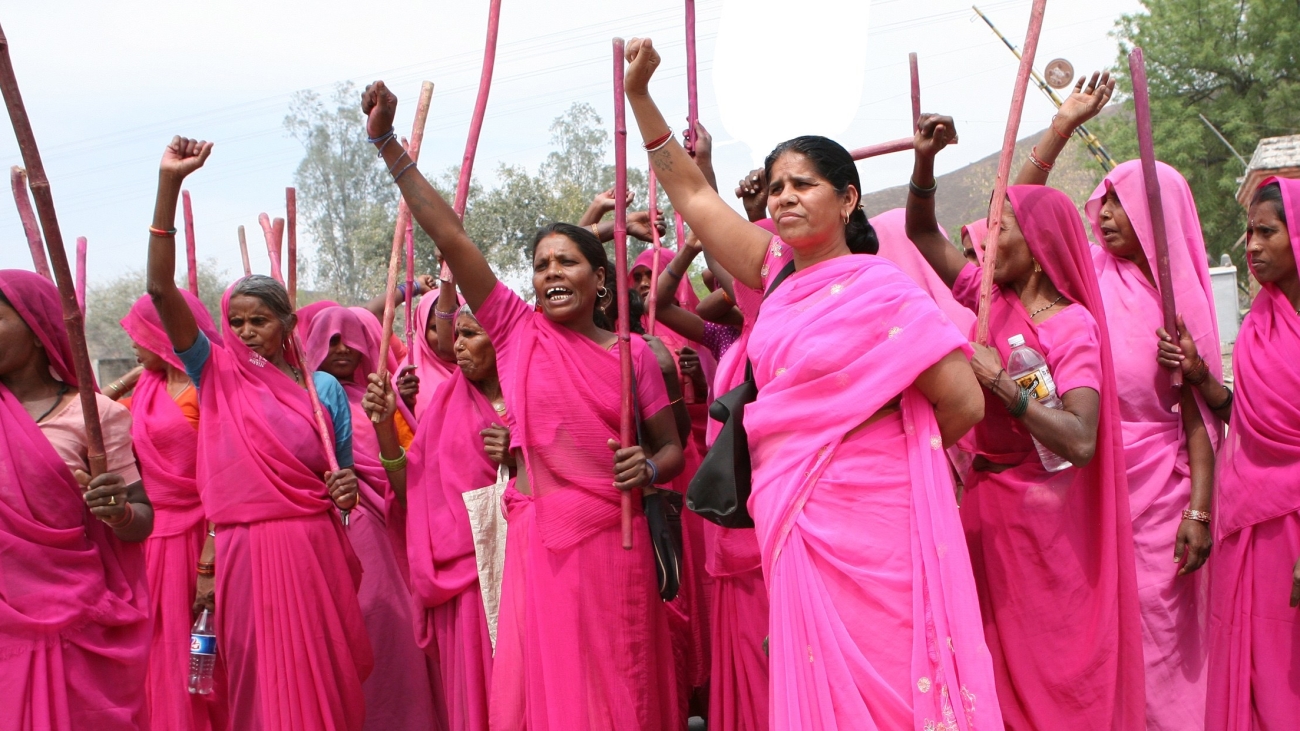
The Gulabi Gang is a group of Indian women dedicated to improving the lives of women. In the state of Uttar Pradesh, dressed in their trademark pink saris, they fight against violence against women as well as injustice and corruption. In addition to using communication as a tool, they sometimes resort to their bamboo sticks in particularly difficult cases.
Uttar Pradesh, 2006. Sampat Pal Devi is on her way home when she hears screams coming from a neighbor’s house. Looking through the window , the young woman sees an enraged man beating his wife. She tries to protect herself as best she can and repeatedly begs him for mercy. Sampat cannot just stand by and watch. She asks a group of women standing nearby to help her. The Indian women grab some bamboo sticks, called “lathis,” and run to the house. There, they pound on the door and confront the man. Overwhelmed by the women’s superior numbers, he backs down and promises never to lay a hand on his wife again.
On that day, Sampat learned that women can make a difference when they work together. She decides to use this power to improve the lives of the women in her country. This marks the birth of the “Gulabi Gang.” It quickly becomes clear which social ills the group wants to tackle. In addition to combating domestic violence and discrimination, they also aim to put an end to corruption and child marriage.
Sampat has done good deeds in the past.
The daughter of shepherds has a good reason for setting such ambitious goals. As a little girl, she herself faced discrimination and had to work in the fields instead of receiving a school education. She learned to read and write by asking the male students about their lessons every day.
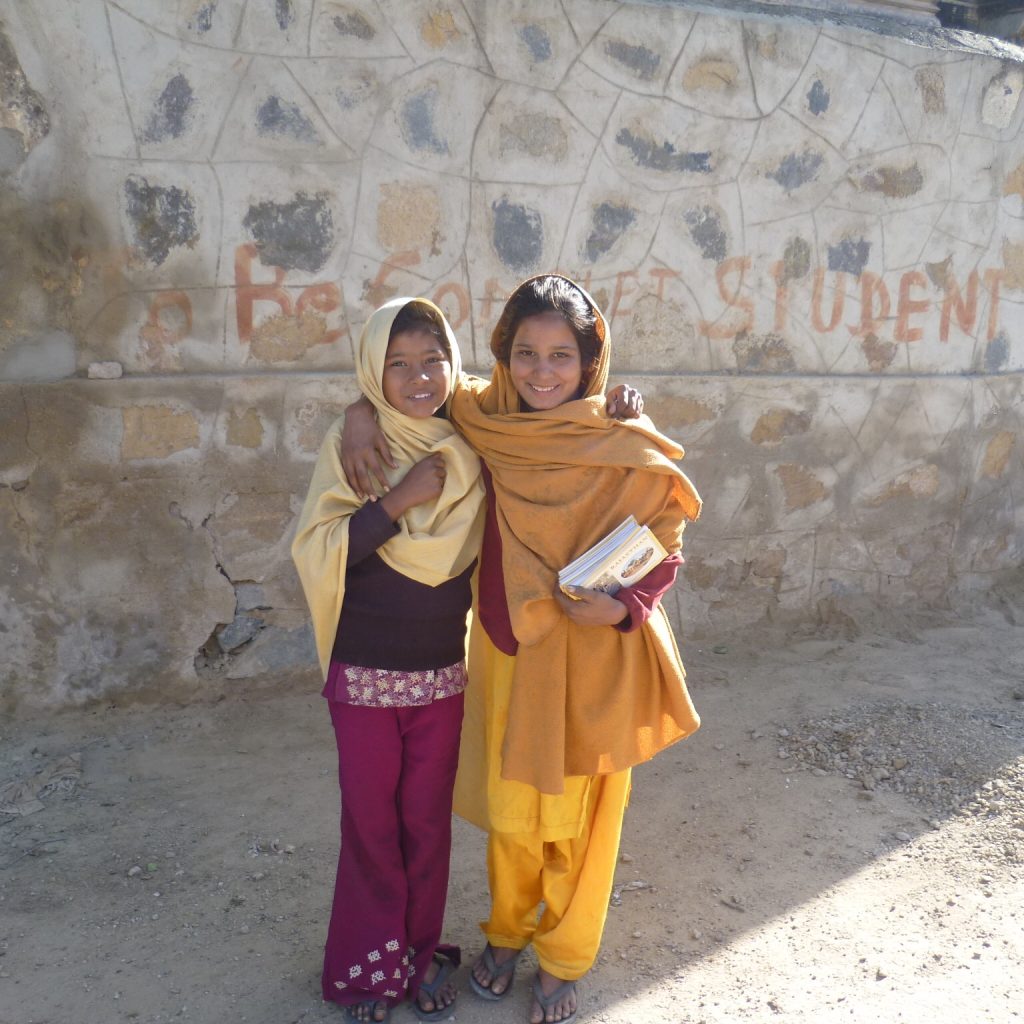
A school education is not a given for girls, especially in rural areas.
Long before the Gulabi Gang was founded, Sampat had been trying to change society for the better. Through her “Einfach Fair Unternehmen” initiative in 2003, she helped Prema Rambahori, a Dalit woman, start her own business. Prema makes organic serving trays and plates out of leaves. The eco-friendly tableware is used at weddings and other events. Prema now employs 500 women, who earn up to 150 rupees a day working for her.
A few years later, Sampat faced the decision of how the women could best represent their values. A uniform—a kind of standard attire—was intended to underscore their unity. Since all other colors were already associated with political parties, they ultimately chose a bright pink. The group owes its name, the Gulabi Gang (Pink Gang), to this shade. The term “gang” has negative connotations and could give the wrong impression. That’s why it’s important to Sampat to clarify the following: “We are not a gang in the traditional sense; we are a gang that fights for justice.”
The Taj Mahal in Agra is the most famous landmark in Uttar Pradesh. The Gulabi Gang is active here.
Reprisals are uncovered at gatherings.
Public meetings are held regularly to give women in the region a voice. At these “chaupals,” women share stories of injustice and violence against Indian women. Based on these accounts, decisions are made on how best to address these issues. This sometimes involves the use of rather unorthodox methods.
For example, when the local police refused to file a report on behalf of a Dalit, the Gulabi Gang organized a mass demonstration. In another incident, they even dyed some dogs pink and marched into the police station with the animals. “These four-legged friends are more loyal and reliable than the police,” the outraged women declared to the bewildered law enforcement officers in front of the assembled press.
Conflicts with the authorities arise time and again. For example, there was already a physical attack on Sampat by a law enforcement officer. However, this dedicated woman successfully fended him off with her bamboo stick. Because of this and other situations in which the group used their lathis, they were labeled “militants.”
The women in pink saris talk first before reaching for their sticks.
In doing so, they first try to resolve conflicts through dialogue. Unfortunately, these efforts are thwarted by a matriarchal society that severely oppresses women in rural India. Dalit women are particularly affected. Although discrimination against the Dalits—formerly known as “untouchables”—has been prohibited since 1950, it remains commonplace in many regions.
In 2008, the Gulabi Gang scored a double victory in this regard. They founded a school for about 400 girls. There, the girls learn to read and write and receive a general education. A Dalit was hired as a teacher—someone who had not been considered by any other school.
The organization, which has now grown to an estimated 40,000 members, is funded by donations. It receives no government support, even though it performs important social work. In addition to its other responsibilities, it ensures that older women receive the pensions to which they are entitled. Many of them can neither read nor write, and some do not even have a birth certificate to prove their age. By scheduling an appointment with a licensed doctor, their age can be verified and the pension application can be completed.
The Gulabi Gang has since attracted a great deal of media attention. In addition to the award-winning documentary *Gulabi Gang* by Nishta Jain (2012), there is also a film (*Pink Saris* by Kim Longinotto) and a book by Amana Fontanella-Khan titled *Pink Sari Revolution*. Their extensive charitable work has also been recognized with numerous awards.
Here, you can support these women in their struggle and even become a member of the Gulabi Gang yourself.
India would be a dream vacation —if only it weren't for all the planning and organizing? I can help with that! From choosing the right destination to finding accommodations and planning excursions—and, of course, including flights and visa processing.





Add a Comment